What do you need in a Virtual Office?

It’s no secret, the number of people working at home and from remote locations is rapidly escalating.

As the Office for National Statistics (ONS) prove, in the first three months of 2013, approximately 13.9% of the UK workforce worked from home offices, the highest number since records began in 1998.

As our blog about how technology is changing the way we work specifies, technology such as Cloud has made homeworking a reality. Despite the unprecedented growth of home working, an office within a home-based setting has limitations.

A Virtual Office is designed to combat the limitations of a home office. Whilst the advantages of a virtual office are fairly blatant and undisputed – namely giving a business a professional address and subsequently a more specialised image – it is safe to say there are several features of virtual offices that remain significantly less recognised and celebrated.

If you are deliberating joining the thousands of SMEs and professionals in their pursuit to take their company and working ventures to new elevated levels by getting a virtual office, take a look at some features of this increasingly popular working practice, you may not realise you need.

So, what do you need in a Virtual Office?

Unlimited post

A company’s post piling up at home isn’t particularly conducive to professionalism. Nor is failing to be in to collect an important parcel or letter. A Virtual Office immediately eradicates such potential problems.

Virtual Offices, such as WorkWell’s Virtual Office, include unlimited post as part of the package. Ensuring all letters and parcels are picked up and collected in a professional manner will not only mean a crucial company letter isn’t chewed up by the family dog never to be seen again, but will also be collected in a professional manner, heightening the credibility of your company.

Unlimited phone calls

How many times do you get interrupted, your trail of though lost, by the phone ringing? You might not realise it but when you have your own Virtual Office you will have the privilege of having a professional receptionist answer your calls.

Delegating the essential, if not mundane, task of having someone else pick up your phone calls will mean you can enjoy an uninterrupted day’s work and concentrate on elements that will ultimately make your business grow.

The same ‘professional enhancing’ principle of having a receptionist professional deal with your post can be applied to the unlimited phone calls that users of Virtual Offices can take advantage of. With a receptionist answering your calls and either forwarding them to you or to your answering machine will not only mean you can get on with more pressing components of running a business but it will also mean you never miss a call.

Use of a desk

Whilst Virtual Offices are predominantly centred on giving businesses the professionalism of having a glamorous address, as well as phone call and mail forwarding services, it can be equally as beneficial to many SMEs and freelancers to have a desk they can use.

For example, Carrwood Park’s co-working spaces enable workers to reap the benefits of having a professional office desk, namely access to fast Wi-Fi, IT support, and the buzz, banter and networking opportunities life in an office offers.

Such vital modern working elements are essential in driving a business forward and nurturing success.

Use of a meeting room

So business is picking up and whilst it was once sufficient to conduct client meetings in a local Starbuck’s, with your company rapidly progressing, you require a more professional, well-facilitated and easy-to-access meeting room.

Once upon a time you might not have realised you would be needing a meeting room but as your business grows so does the need to hire a professional, well-facilitated meeting room.

Take advantage of Carrwood Park’s meeting rooms, which being just 15 minutes from Leeds City Centre and two minutes from the M1, means your guests can show up and enjoy a professional meeting in the most stylish of environments.

Location, location, location

Estate agents love to say it but the popular phrase ‘location, location, location’ is being adopted by virtual offices.

The location of an office, virtual or not, is important for several reasons. With a desirable and professional-sounding business address, clients, potential clients, outsourced and others are likely to view your business venture with greater credibility.

What’s more, using an office that is located in a stylish building, on the outskirts of a large city or town with convenient access and free parking, will not only be more convenient for you to use but will be easier for clients to visit.

If you have any further questions or would like to arrange a viewing or book a Virtual Office at WorkWell, please don’t hesitate to get in touch.

Five marketing tools every SME should be using

Starting a business is hard work. According to serial businessman and former dragon in Dragon’s Den star Theo Paphitis, 50% of all small businesses fail in the first couple of years in the UK. They say if you are going to fail, you should fail fast. But could these high levels of failures be preventable?

While the nature of the business and the services and products it provides is the defining feature of an SME and its subsequent success or failure, efficient marketing strategies are crucial to creating a buoyant SME that begins to thrive instead of withering.

With a myriad of marketing tools, techniques and services available, knowing which marketing avenues to go down can be a worrisome headache for any business.

If you are a founder, director or marketing manager of an SME and you want to embark on the most effective forms of marketing to help get the SME off the ground, take a look at the following five marketing tools every small business should be using.

1      Website design

As of 2025, nearly 69% of the world’s population has an internet connection, totalling over 5.5 billion global internet users. With such a vast number of people online, a website is a crucial component of any modern business.

With such a vast number of people online, a website is a crucial component of any modern business.

The quality, style, overall look and usability of a business website have a significant impact on how visitors will perceive your site and your business in general.

A website designer will have the technical and design skills required to build a professional website that reflects your business, its services, products and personality to a global audience without geographical constraints.

2      Content marketing

Once you have a company website up and running, you can’t just sit back and forget about it. We’ve all heard of the almost universal gripe, if a website isn’t on the first page of Google, it might as well not exist. For an SME, a website’s rankings on the search engines can mean the difference between survival and bust.

You will need to think about keeping the site optimised for search engine optimisation (SEO) purposes. One way to achieve good SEO – search engine rankings – is through content marketing. A well-written website scattered with a healthy amount of keywords is likely to be rewarded by the search engines by being ranked highly.

Regularly updating the blog on your site with quality, relevant and unique content will mean the search engines scan your site and boost your rankings.

With the internet becoming an increasingly integral part of society, it has become a priority for many SMEs to build a strong online presence, and one way to do this is through content marketing.

3      Social Media

Another way for an SME to develop a strong online presence is through social media. As the Digital Donut writes, you don’t need to own a large corporation with a hefty marketing budget to make social media work. Research has revealed that small businesses are more likely to “strike the right tone” on social media than large companies.

Being active on social platforms by regularly posting and engaging in discussions can help an SME build customer relationships, ultimately nurturing and increasing leads.

With 87.3% of consumers in the UK reading online reviews before making a purchase, interactions on social platforms can help an SME achieve positive reviews.

4      Brochures

Brochures can be a great way for an SME to deliver information about its company profile, services and products to potential clients and customers. It is important for an SME to know their clients and target audience well in order to judge what information it should share in its brochure.

The design of the brochure should be carefully considered as the presentation of this important marketing tool will make a significant impact on the impression you are trying to create about your company.

5      Exhibitions

Exhibitions can also be an effective marketing method for SMEs. The right exhibition and design stall will give an SME the opportunity to showcase its strengths to the right audiences and business prospects, ultimately helping generate leads and sales.

There are many other great marketing tools designed to help SMEs prosper and succeed. See our blog about apps that can help save businesses time is a great read for those considering using modern technology to help run their business more efficiently.

Are you an SME who has first-hand experience of a marketing tool that has helped your company grow? We’d love to hear about our readers’ business experiences. 

Will opening a virtual office improve my SEO on Google?

You may not realise it, but many of your business contacts, colleagues and associates are making use of virtual offices.

The reason you may not realise this is actually one of their main benefits – because virtual offices give you a physical address for people to contact, even if you can’t afford or don’t need office space.

But what exactly is a virtual office?

This is a question that is often asked about virtual offices, and not everyone has the correct answer to what a virtual office actually is. This type of office space is not just a post box, but access to a full range of facilities – from a manned reception and call answering service to desk space and access to fully equipped conference and meeting spaces. In a normal leased office, you would need to pay for all of these services all of the time, even if you only needed them occasionally. One of the main reasons to choose a virtual office is that it gives you access to these services when you need them, and you only pay for what you use.

Exploring the SEO benefits of a virtual office address

However, there is another very important benefit of using virtual offices – improved search engine optimisation (SEO). You may have a fantastic website, optimised for high rankings in Google and other search engines, as well as investing in many other ways to improve your SEO, but there are some parts of Google that you simply can’t access without a physical address.

A key example of this is Google Local, a service designed to help users search within their local area. This localised service makes it difficult for search engine users to find businesses that don’t have a physical address, which, of course, shows up on other services such as Google Maps. Google Local relies on maps in order to place your business, and it gives priority to listings with a physical address that can easily be read.

So, what does this ultimately mean for businesses without a fixed and permanent office address? Without a virtual office from a provider such as WorkWell, which gives you an all-important address and one in a central location near a large city, you may not even be able to reach potential customers in your local area, never mind being able to extend your reach to the rest of the country. A local listing is an essential building block, helping to establish a strong presence in your area before reaching further afield.

5 businesses that could find virtual offices very useful 

As we mentioned in a blog about who should use a virtual office, there are a few obvious candidates. For example:

1. Businesses wanting to expand and test the market in a new region might want a virtual office for the reasons already listed – namely, getting a Google Local listing.

2. Growing SMEs want to keep their finances flexible while getting their business off the ground.

3. E-commerce websites often find that virtual offices are great alternatives to regional call centres, with the added benefit of extra credibility.

4. Sole traders and freelancers needing to keep on top of all calls, correspondence and orders, but without committing to full-time office space, as self-employed business owners can never be sure where their next business is coming from.

5. Start-up companies wanting a prestigious physical address in a strong business location (i.e. near a big business hub such as Leeds or London) that lends them credibility and a highly professional image.

To find out more about virtual offices at WorkWell, see our range of virtual office packages.

For more advice and tips on finding the ideal office space solution to suit your business, subscribe to our blog.

Face to Face Meetings VS Teleconferencing – with infographic

As companies strive to adopt telework initiatives, teleconferencing has increased rapidly in recent years. The primary advantage of teleconferencing is clear – it enables businesses to conduct meetings with clients, colleagues and partners who are geographically dispersed. Whilst teleconferencing continues to gain momentum, meeting and making decisions over the phone is not always the answer.

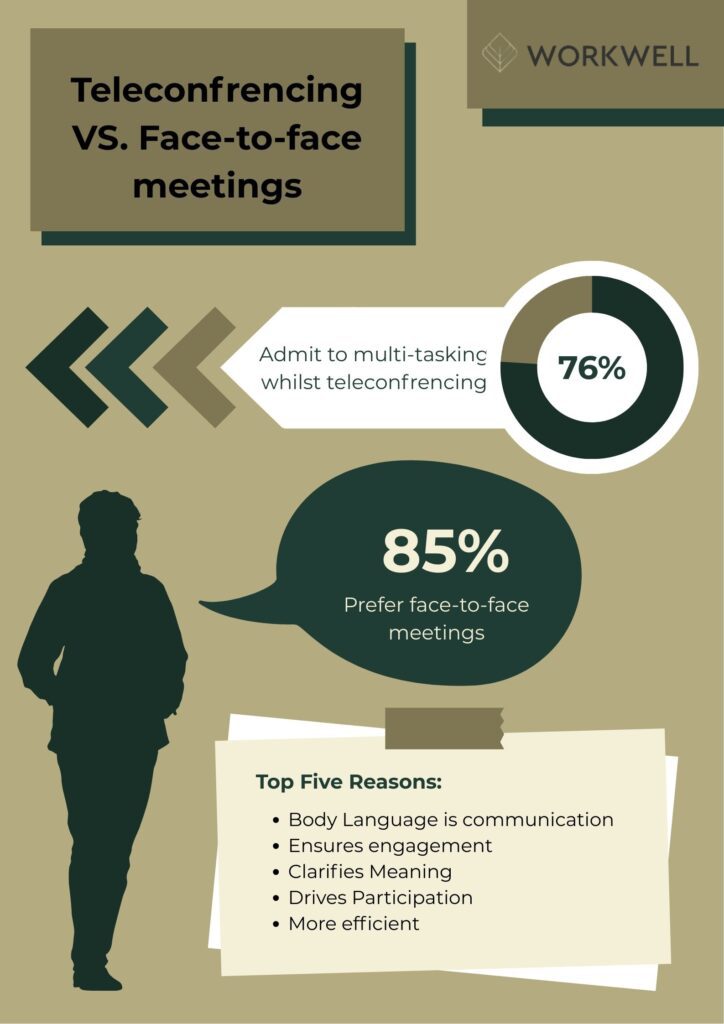
Business owners and corporate managers might enjoy the geographical freedom and flexibility digital communication tools create, but did you know that 47% of professionals admit to losing a contract or client because they failed to allow for enough face time?

With this in mind, take a look at some of the reasons why face-to-face meetings are as important as ever and will never become obsolete.

Body language

Body language and business have long been intrinsically associated. Smiles, eye contact, a firm handshake, good posture, and the head held high are just several body language gestures that convey a message of confidence, self-assurance and a ‘work with me and you won’t regret it’ attitude.

As Carol Kinsey Goman, a coach on leadership, body language and professional success, told Forbes:

“Body language plays a key role in effective leadership communication.”

Of course, in teleconferencing, body language doesn’t exist.

When communicating virtually, all those subtle body language and facial gesture clues are lost, meaning it is less easy for people to make an evaluation and to judge other people’s skills and attitudes.

Millennials prefer face-to-face meetings.

One might assume it’s the youngsters, those known as the Millennials, who are in favour of this modern form of business communication.

Not according to an infographic created by CT Business Travel and NeoMam Studios, which shows 80% of Millennials prefer face-to-face communication with colleagues.

More effective

Having an important meeting via a phone or video is super convenient, but is it as effective as meeting face to face?

We’re all guilty of it. Flippantly flicking through our Facebook feed whilst engaged in an important conference call or instant messaging meeting.

As the Time Management Ninja writes, the problem with teleconferences is that most people “aren’t there” and “without discipline they can be wildly ineffective.”

Phone conference participants/attendees, according to the report, are doing everything “but listening to what is happening on the call.” As teleconferencing attendees lose concentration, background noise is inevitably generated, which can be wildly off-putting for others on the teleconference.

The CT Business Travel and NeoMam Studios infographic reiterates this point, finding that 69% of people admitted to browsing social media to pass the time during audio-only calls.

Gauge an understanding of a company’s personality and culture

As well as obliterating the emotion afforded in body language, virtual communication quashes our ability for people to witness a company’s personality and culture first-hand.

By attending a meeting in person, you can see what an organisation’s culture is like. Whether the company seems relaxed and friendly or whether it’s more structured and corporate.

Whereas teleconferencing is typically ‘strictly business’, face-to-face meetings allow for a business’s personality to shine, which is an important trait when you are thinking about doing business with or working for a company.

A meeting room says a lot about a company.

As we wrote in our blog titled ‘5 meeting preparations to ensure a successful meeting’, “a room in which a meeting is held says a lot about a company.”

When you participate in a teleconferencing meeting, you have no idea where the other participants are located. They could be ‘attending’ the meeting from a home office, a Starbucks café or a library for all you know.

By contrast, when you attend a meeting in person, you have the opportunity to be impressed by the location of the meeting.

A professional, well-facilitated, bright and well-designed meeting room talks volumes in portraying a company in a professional and quality light.

Hire a meeting room

If you’re a start-up or a small business, you might be of the opinion that, without a professional office location, you have little option other than to conduct meetings with clients, potential clients, contractors and colleagues via telecommunication tools.

The great news is you can hire a meeting room out. Naturally, there is plenty to consider when hiring a meeting room, such as what the facilities are and what the price includes.

For advice on booking a meeting room, take a look at  WorkWell’s blog on ’18 things you need to know before you book a meeting room.’

Teleconfrencing VS. Face-to-face meetings

In conclusion, teleconferencing might enable us to communicate conveniently without geographical constraints. However, being void of personality, body language, participant concentration and engagement, you should ask yourself just how effective a teleconferencing meeting really is?

For a quality and professional meeting room in Leeds that comprises the latest facilities and excellent transport links, download the WorkWell meeting room brochure

4 Compelling Reasons Why All Freelancers Should be in Co-Working

Being freelance has its advantages, although, if you’re completely honest, it can be lonely. Sure, you get out to visit clients in a convenient internet café every so often, but that’s not always the most conducive atmosphere for a professional meeting.

As you’ll find by reading this post, renting a co-working space not only combats this feeling of isolation; it offers the self-employed worker many other benefits, without restricting the freedom to come and go as you please.

In order to review how being in a co-working space is preferable to being based in a home office, let’s put it in the context of why over 1.72 million people in the UK    like to run their business this way.

What’s So Good about Freelancing?

The keyword which sums this up is FLEXIBILITY. You’re not tied to clocking in and out, so you can work around your timetable. Supposing you’ve chosen this lifestyle because you’re a parent, as many people have, you don’t have to decide whether to miss your child’s school play or take time off work. You can watch your child’s success, then catch up later in the evening.

What’s Not So Good about Freelancing?

It’s all very well being able to hang the washing out while the sun is shining or visit your elderly relative during the day, but with so many distractions, it can be hard to settle down and concentrate.

You can see a detailed analysis of how co-working is better than working from home here.

With a co-working desk, it can turn the downside around, giving you the best of both worlds.

Four Ways Co-Working Enhances Freelancing

Renting a co-working desk is not a huge investment. The positive aspects often result in increased revenue, which more than covers the cost. There are many other reasons why efficiency is enhanced, and here are four of them;

1. You have to be a special kind of person to keep motivated when working alone all the time. Having access to a co-working space doesn’t mean you have to commit to being there all day, every day. What it does give you is a fully functioning office with flexibility when you need it, plus an opportunity to interact with others in a similar position.

2. Sometimes you need to get out of the house to concentrate. A desk in a quiet, professional working environment with super-fast wifi and easily available tea and coffee (as opposed to a noisy internet café where you may have to waste time in a queue for twenty minutes) means you can be productive in no time at all.

3. Your credibility rating is raised in an instant with a professional meeting space to meet clients and an address to put on your website, which isn’t in a residential area. Increasing your credibility can lead you to more valuable customers.

4. Networking is a vital aspect of successful freelancing. By carefully choosing the right location, you can find yourself next to individuals offering services which are complementary to yours. The opportunity to provide collaborative packages to prospects is another way you can increase your income stream.

Realistically, there aren’t currently enough co-working spaces available in the UK for almost two million freelancers, so it might be wise to start looking into it now. If you’re beginning to think it’s the right move for your business, why not try a free week’s trial at WorkWell? There’s no obligation, but you might find it’s something you can’t live without.

How to size your office

If your company is making the leap and leasing new office space, you have a very important decision to make. How much space do you need? Choosing the right size is crucial for several reasons:

  • Comfort and morale of your employees
  • Legal regulations – are you allowing the right amount of space per person?
  • Practical and productive functioning of the office
  • Cost – are you paying too much for space you just don’t need, or could access to more space be one of the hidden charges of leasing a serviced office?
  • Growth – does the space you have allow for the future growth of the business, or would you prefer to jump to a larger serviced office as and when you need to?

What is the legal requirement for office size?

The crucial thing to consider when working out how much office space you need is the Health and Safety Executive’s guidance on the issue. HSE regulations insist that workrooms have enough space available for people to move within the room and between workstations with ease. When the room is empty, the total volume of the space, when divided by the number of people working in it, should be at least approximately 53.2 square feet.

At dedicated meeting and office spaces like WorkWell, the operating rule of thumb is to leave 60 to 70 square feet of space per person. However, this is dependent on the room size, shape and the furniture and equipment in the space. As a rough guide, a 2-person office requires around 85 square feet per person, whilst a 40-person office will need between 45 and 50 square feet.

Don’t forget about the furniture.

When working out how much space per person you need to allow in your new serviced office, you need to take furniture and equipment out of the equation. These are obstacles that take up a person’s space and restrict movement, so you shouldn’t include these when trying to work out the square feet of a room, for example.

What does your business need?

It’s important to know about the minimum requirement of space per person in offices, but you should only use this as rough guidance and tailor the actual office size to the needs of your business. If you want your team to be comfortable, productive and happy, you should always leave more space than the minimum required.

As we note in our Serviced Office Size Guide, in business, common sense prevails, and the amount of space and equipment an employee will require is intrinsically dependent on what their job is and the type of business you operate. For example, an office for a telephone-based business like a call centre is likely to need less space than another type of company, such as a printing firm.

As our ‘Choosing the right size for your serviced office’ document states, a marketing business or print agency of approximately four employees should ideally have an office of about 280 square feet in size.

By comparison, a procurement agency of around 90 employees would require an office of approximately 7,500 square feet.

A medium-sized agency, like a procurement firm, typically spends a lot of time in the office. Working on the sum that the firm has 90 employees, a business like this would require 95 desks, five meeting rooms and one management office.

Making the best use of office space

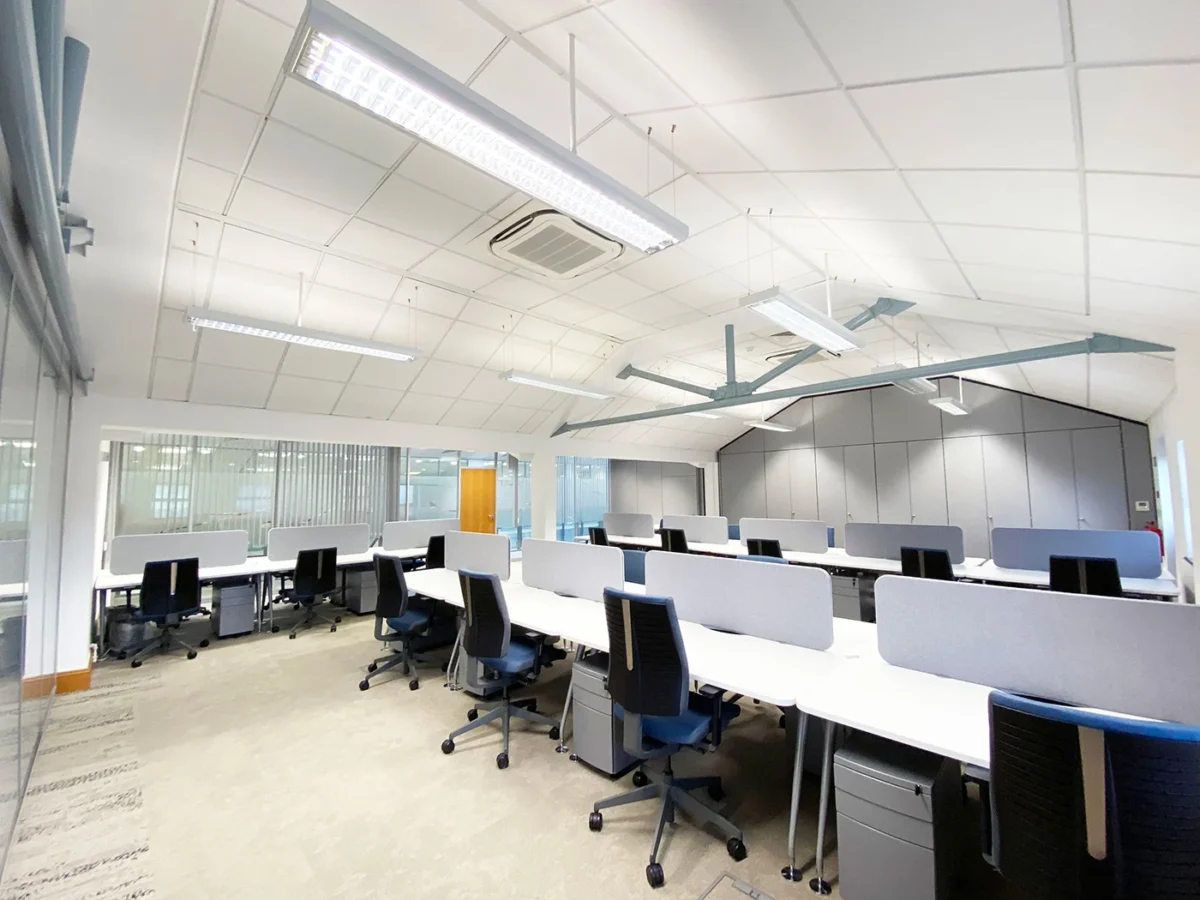
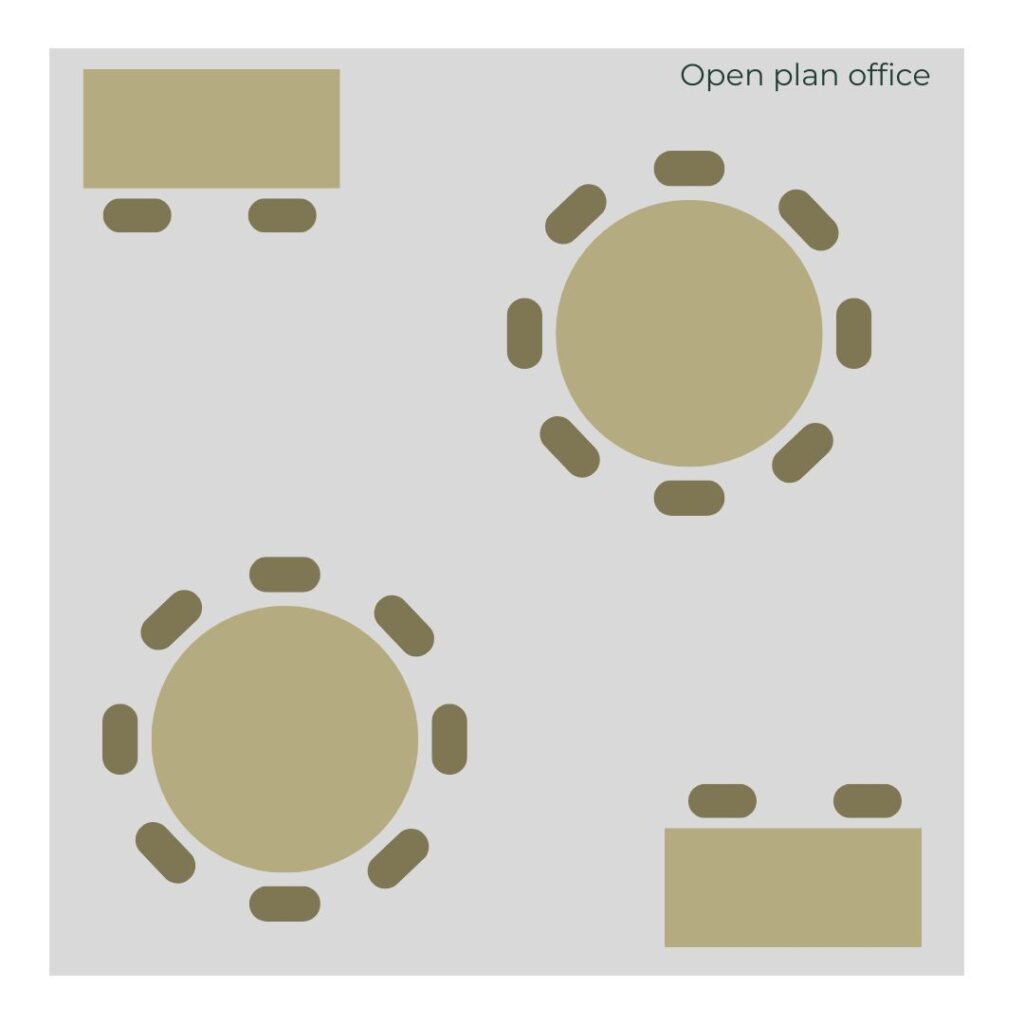
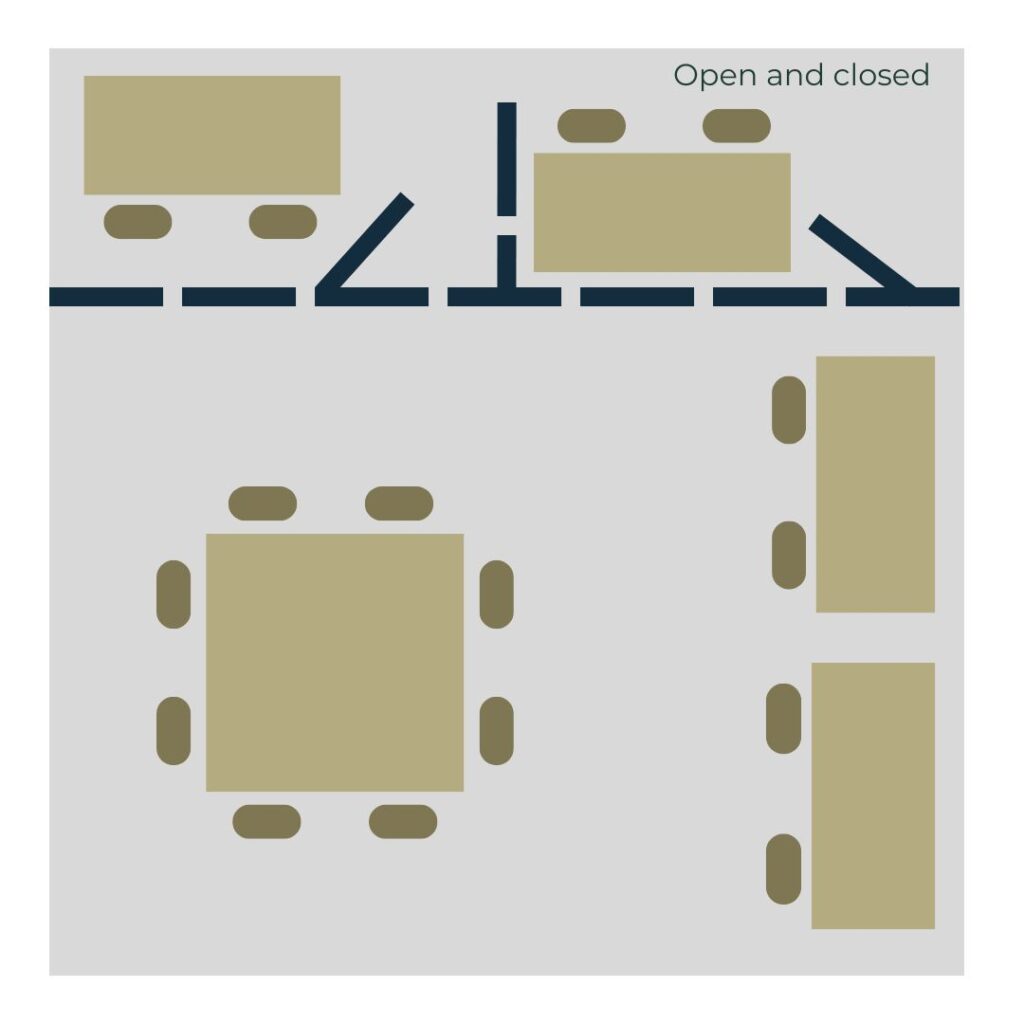
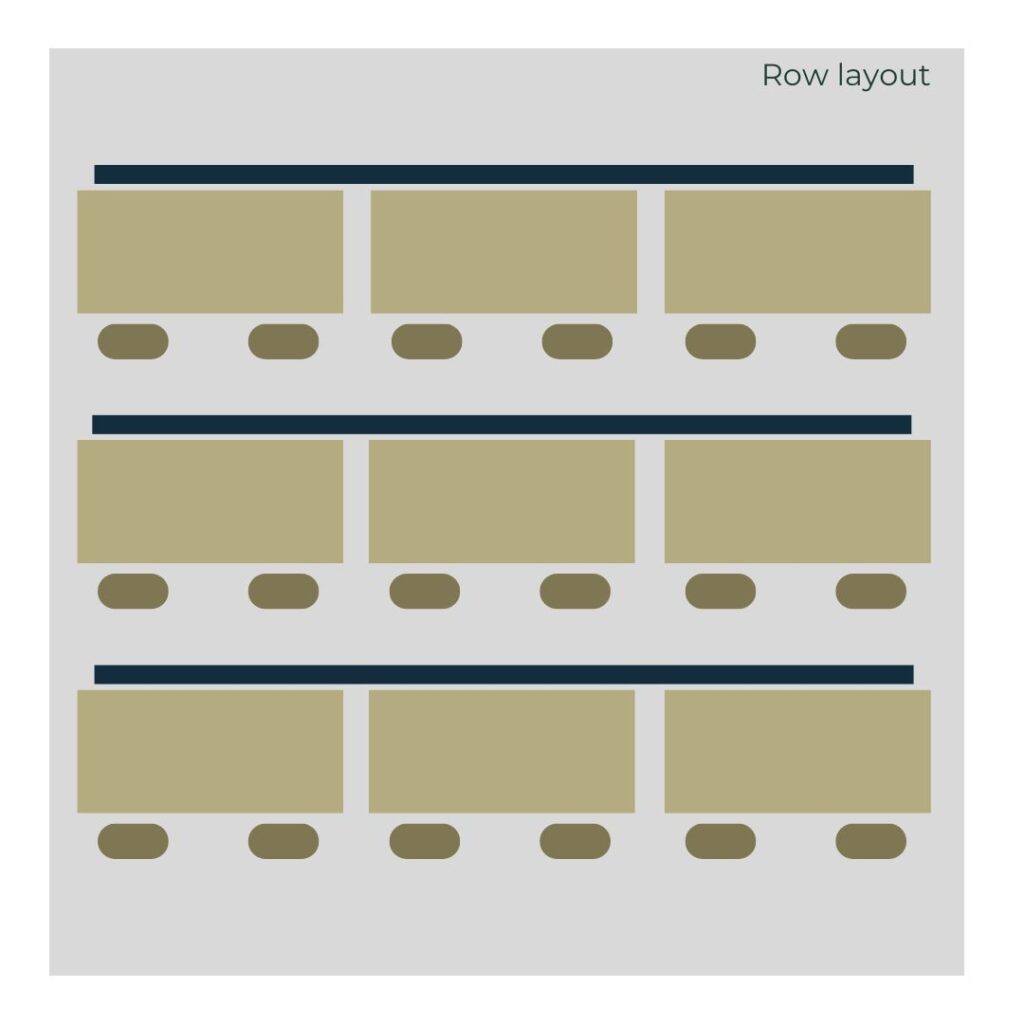
Of course, it’s not just the actual space you have that matters in an office, but what you do with it. As we mentioned in an earlier blog, there are ways of setting up an office to maximise productivity, but also to ensure that all workers are comfortable and have pleasant surroundings to work in. The right layout can ensure a good ‘flow’ through the workspace, with all essential equipment within easy reach and the layout as a whole making logical and practical sense. Here are a few tips on efficient office layout to get you started:

  • Let in plenty of daylight
  • Keep the space well-ventilated
  • Create zones – for example, one zone for computer work and another for informal meetings, collaborative work and breaks
  • Keep groups to between 6 and 8 people – research has shown that this number of people on a bank of desks is more productive and needs less supervision (as it supervises itself)
  • Stick to an open plan to give yourself more flexibility
  • Be smart about storage – keep everything accessible but ensure storage doesn’t eat into valuable office space.

WorkWell recommends that a company ideally have an office with 60 – 80 square feet per employee. This is, however, just a general rule of thumb, and the actual office space your firm requires largely depends on the type of business you operate, your budget and what your employees are required to do.

For more tips on choosing an office and an efficient layout, subscribe to the WorkWell blog. You can also download our serviced office checklist to work out exactly what you need in a new office space.

If you’re looking to develop your business through the help of professional and well-facilitated office space, Leeds is a great choice of city in the north of England. WorkWell are a serviced office company that offers great serviced office space and meeting rooms for hire on the outskirts of Leeds.

The Worst Advice We’ve Ever Heard About Meeting Rooms In Leeds

Everyone has their own opinion on what makes a good meeting room, but some are just plain wrong! Here are just a handful of the worst pieces of advice we’ve heard about choosing meeting rooms in Leeds:

  1. The layout of the room doesn’t matter – all you need is a table and chairs. As our blog points out, so many people are under the misconception that for a meeting to happen, all you need is a group of people gathered in a room with somewhere to sit. This just isn’t true, as the layout of the room can make a huge difference to the outcome. For example, you might need space to collaborate in small teams, or one speaker might need to address a large number of people at once. You don’t want to run out of room for everyone, have people facing the wrong way and having to crane their necks or not being able to see someone properly (or look them in the eye while they’re talking). There are lots of different layouts you can try to ensure you get the very most out of every meeting – take a look at Geoff Dollar’s Slideshare presentation to get some ideas and invaluable advice on layouts for your next conference.
  2. It’s a good idea to choose a  venue that is plain and austere in its décor, so that people can concentrate. The idea behind this is that some people are so easily distracted that good design and interesting colours will distract them from focusing on the meeting – which we all know is a load of nonsense. The opposite can actually be true, where people feel inspired and extra-creative when they meet in well designed, well decorated spaces.
  3. You don’t need a meeting room if you’re a home worker – you can hold it in your home office! Picture your home office and imagine your dream client – that big fish you’d absolutely love to land – sitting in it, and you’ll see why professional meetings in home offices don’t work. However much you try to separate home or work life by creating a dedicated workspace, home distractions will soon start to seep in – as smarta.com points out in a recent blog. You end up distracted by phones ringing and clearing up clutter as fast as you can, while your meeting participants feel uncomfortable hearing kids yelling and dogs barking while they try to discuss important issues. The bottom line is that this kind of unprofessional setup won’t impress anyone, and they’ll leave thinking that you too are unprofessional.
  4. Always go for the cheapest option available. After all, you only need a closing door and somewhere to sit to have a meeting, right? Wrong! The space you choose for your meeting is hugely important and it needs to be tailored to your needs. You need to have enough room, access to the right facilities and technology and extra services like hospitality, Wi-Fi and toilets so as to impress important attendees and keep them happy through longer sessions. Holding your meetings in a bargain basement (sometimes quite literally) space just won’t cut the mustard – it will make your company look cheap, unprofessional and like it doesn’t care about the comfort of its meeting participants. Besides that, you’re not very likely to get very much done in a cramped, cheap meeting space that doesn’t meet your needs.
  5. You should always go for a city centre location. While this can be useful if everyone in your meeting is coming from the same small, central area (which hardly ever happens), city centre locations can actually be very inconvenient for many delegates. Public transport can be crowded and expensive, while the roads are congested. What you should be looking for is a location near to a big business city like Leeds or Manchester, close to public transport and road links but without all the issues of the city centre. A location just on the outskirts is perfect, and you might even end up with a lovely view of some greenery and countryside rather than just miles of concrete and glass.
  6. Extra services are a waste of money. When considering meeting rooms in Leeds and trying to find the best space for your needs, you’re likely to come across venues like WorkWell which offer extra services as part of meeting packages. If you think they’re a waste of money, consider the meetings you’ve attended over the last 12 months. How many times did you experience technical problems, when it would have been amazing to have an IT support whizz swoop in and set things straight at no extra charge? How many times have meetings overran and everyone is desperate for something to eat, and it would be great to have hospitality on hand with refreshments without disrupting the meeting? What about printing and faxing, or accessing data that you don’t have with you – or needing to start a video conference with someone who couldn’t make it but whose input you really need? These are the reasons why extra services can be invaluable, and well worth paying a little extra for.

There are lots of things that can spoil a meeting – as Eric Matson explains on Fastcompany.com – but choosing the wrong meeting room can be one of the biggest problems. Don’t listen to the bad advice! Think about what you need from a space and what your meeting participants expect, and go for good value, professional and flexible Leeds meeting rooms every time.

For more advice and tips about choosing meeting rooms and indeed, running a successful meeting, subscribe to the regularly updated WorkWell blog.