The phone’s ringing, the dog wants to go for a walk – he’s just jumped up onto the kitchen counter and knocked your paperwork on the floor. You’ve got a meeting in the lounge in half an hour and the neighbour’s just popped in for a chat having seen your car in the drive. To top it all, the washing machine’s just started leaking. Sound familiar?
Co-working, virtual office space, shared offices, they all give workers who work independently from a ‘traditional’ office the chance to reap the benefits of working alongside other people in a flexible and modern way.
So they’re all the same, right?
Wrong!
Well, semi-wrong anyway. Whilst modern working environments such as co-working spaces, shared offices, and virtual office space collectively provide independent workers with the chance to network and bypass tiresome office commutes, there are some fundamental differences between them.
As we wrote in an earlier blog, 90% of UK professionals now believe flexible working is the way forward and choosing when and where you work is rapidly snowballing in the UK.
If you are keen to jump into the shared office working environment but are unsure which option of office to go for, take a look at the differences between co-working spaces and virtual offices.
Co-working spaces
Co-working spaces are essentially shared office environments in which the individuals who use them are not usually part of the same organisation and work independently.
What do co-working spaces include?
A well-equipped co-working space will include all the essential office equipment, including:
Wireless internet access
Scanners
Printers
Fax machines
A co-working space will have the vital office furniture such as chairs and tables, meaning you simply bring your own device and you’re ready to start working.
The better the co-working space is, the higher quality and more comfortable the furniture is likely to be. WorkWell’s co-working facilities, for example, include British designer leather furniture for a real luxury working environment.
Other features which are often at workers’ disposal in a co-working space are:
Tea, coffee, water and even kitchen facilities so you can brew up and prepare food at your leisure.
Temperature control means the working space doesn’t get too hot in the summer and too cold in the winter.
Many co-working centres, which are located on the outskirts of a city, such as Carrwood Park, will have free on-site parking.
Meeting spaces
Many larger co-working centres will have presentation and conference facilities available. Having access to a meeting room and presentation facilities can be crucial for giving independent workers and organisations a truly professional edge by enabling them to meet existing or potential clients and interview employees in a professional space.
Who uses co-working spaces?
As the opportunities for networking, collaborating and mentoring with other professionals in co-working centres are prolific, they are popular amongst freelancers and start-ups who want to secure more business and help their business grow.
Being equipped with meeting room access, co-working spaces are also suitable for SMEs who want to work in a professional environment but without the hefty overheads of a traditional office lease.
They are especially popular amongst independent tech and digital workers, who require reliable and fast Wi-Fi and benefit from a ‘buzzing’ working environment.
Virtual office space
A virtual office in leeds is the perfect way for a company to invest in their image or brand and consequently increase their visibility and credibility without having to make a heavy investment on office leases.
What do virtual offices include?
Virtual offices provide most of the same benefits of having a traditional office, including:
A receptionist
A call handling service with mail forwarding
A lucrative business address
Parcel handling service
Virtual offices typically come in different packages. For example, Carrwood Park offers four different types of virtual office packages.
The first is the DDi Number package which provides a business with a landline which can either be forwarded to a mobile phone or to a personalised voicemail.
The second option is the Registered Address package which offers a professional business address with mail collection, which receives company mail and forwards it on. Having a professional business address in a lucrative location can have a significant impact on how others perceive an individual professional or a company, which can make the difference between securing contracts and not.
Then there is the Reception Answering option in which a company’s calls are received by a front of house receptionist who then forwards the messages to appropriate individual.
Many virtual offices offer all the mentioned services in one package. For example, Carrwood’s fourth virtual office package gives individuals and organisations the change to work from home or independent of a traditional office but still reap the benefits of having a full virtual office package.
Who uses virtual offices?
Virtual offices are most suitable for small businesses and start-ups which seek a virtual space and the benefits of a conventional office but are not yet ready to move out of a home office or take on the financial burden of a traditional office lease.
Virtual office users often use virtual office in the initial stage of their development until they are sufficiently big enough or have the financial means to take on ‘actual’ office space.
In short, having a glamorous business address on a business card can go a long way increasing a start-up’s or SME’s credibility.
Whether you opt to work from a co-working space or a decide a virtual office would be more beneficial to your own personal circumstances, these flexible working platforms provide professionals and businesses with a cost-effective, professional and modern way to develop business and nurture company growth.
For more information on hiring quality and well-equipped co-working and virtual office space in Leeds or Harrogate, get in touch with WorkWell.
If you work from home, you are no longer in a minority. In fact, according to official figures by the Trade Union Congress (TUC), you’re one of more than four million people who now regularly work from home in the UK.
Working from the confines of your own home has its obvious advantages – no lengthy commutes, no time or money wasted on travel, no concern about suits and other fancy work outfits. The list goes on and on. Despite the obvious benefits, homeworking is not all fun and glory. In fact, it can be decidedly un-fun!
Richard Branson started his entrepreneurial career running his first business from a friend’s basement. Branson spent many hours in a lonely, damp and dark basement working on a student magazine called Student.
As Virgin.com states:
“While not all budding entrepreneurs start out in such unglamorous conditions, most are familiar with the strains of working from home or in less than desirable circumstances….”
“…The number one complaint from many who work from home is loneliness, with many people unprepared for the isolated working environment.”
The good news is, that unlike when Richard Branson was starting out back in the 60s, there is now a glamorous, well-facilitated and ‘buzzing’ option for independent homeworkers to work in – co-working centres.
If you lack the banter, companionship and professional surroundings as you battle each day on your own working from home, you may want to consider communal working.
The rise of the co-working offices
Shared workspace is becoming an increasingly popular way for creatives and freelancers to work. Co-working centres provide office space and facilities for freelancers, start-ups and small businesses to work in a unique environment in which they can collaborate and grow.
Co-working centres provide members with all the benefits of a ‘proper’ office but without the hefty price-tag. They encourage collaboration between members of diverse backgrounds and industries, which can prove instrumental to business growth.
OK so we’ve sold co-working to you. Like the world’s most famous and successful entrepreneur himself, you’re determined to give up the dark and isolated confines of your home office – if you can call it an office – in favour for a desk at a glam co-working office.
But before you do so, you may want to read the following tips on co-working etiquette and ultimately ask yourself the question: Are you polite enough to co-work?!
Essential co-working etiquette
Collaborate and network by all means, but don’t hard sell to others.
The very essence of co-working is to help independent workers and small business owners network and develop their business ventures. With this in mind, introducing yourself to a fellow co-worker at the coffee machine and talking about what you do is great and almost expected.
Disturbing fellow co-workers by over-zealously shaking everyone’s hand the minute you walk in the office, won’t do you any favours. In fact it might even cause other co-workers to make a mental note, not to visit the centre when you are there!
“Co-working is built on trust”, says Michael Clingan, author of ‘Close That Sale!’ “Using the co-working space to sell violated that trust.”
Refrain from constantly talking loudly on your phone
So running a small business and working for yourself does require some verbal communication via the telephone. Consequently, many co-working centres are equipped with phone lines so workers can have their own landline number.
Whilst the very nature of working under the same roof as other freelancers and creatives demands a lively, buzzing and atmospheric environment – the type many homeworkers both lack and crave – nobody wants to be drowned out or unable to think due to an exceptionally loud fellow co-worker who seems unable to prize their phone from the side of their face.
Respect the fact that people are members of co-working centres to work. If they wanted to work alongside the constant whir of exceptionally loud salespeople on the phone, they would have chosen to work in a call centre!
Be friendly
One of the best parts of giving up your six years of working in a 9 – 5 job in a corporation that got you nowhere is that you no longer have to smile at people you don’t like. However, having the freedom to not be forced to communicate with colleagues you couldn’t give the time of day, shouldn’t mean you have a ticket out sourly scour at everyone you meet.
Your year or two working from home in isolation may have turned you into a tad of a socialising sceptic, but now’s your chance to meet new, like-minded people and even potential friends, providing of course, you’re friendly. What’s more, your friendliness can soon transpire into networking and ultimate business growth.
As Forbes writes:
“The best part about this is that being friendly is actually a covert networking manoeuvre. Co-working communities are excellent sources of information, knowledge, leads and skills, and as you get to know your neighbours, you’ll find ways to help each other out. ”
A rather dishy freelance web designer holds the door open for you as you walk into the office, you smile politely, say thank you spend the rest of the day trying to muse up the courage to ask him to go for a drink. OK so that’s one perk of co-working we’ll refrain from elaborating and jokes aside, every member of a co-working office should be well-mannered and respectful of other members.
As well as being well-mannered and polite throughout the whole of your co-working duration, you should also mind your meal manners.
“If there would be only one rule for all co-working spaces, it would be this: The kitchen is sacred – don’t mess it up,” advises The Muse.
Make good use of the free tea, coffee, water and even beer and wine in some centres, but don’t take the mickey, always tidy up after you and keep your mitts off other people’s goodies!
If you’re freelancing or starting your own business in Yorkshire and miss the banter and facilities of office life, you may want to think of joining WorkWell and our flexible, professional, state-of-the-art and friendly co-working in Leeds and Harrogate.
“Would you like a coffee?” “What’s your opinion on the Ukraine crisis?” “Would you collate this information as an infographic or on a traditional pie chart?” “Do you fancy coming for a drink this evening?”
I love interacting with people on a daily basis. I love the community of the office. In fact, I know that working alone and having a professional environment would be really difficult for me.
Would you miss the repartee, co-worker ‘loyalty’ and general companionship if you no longer worked in an office?
Or, perhaps more importantly, the big question in flexi working. Does co-working increase productivity? Is the banter and working in a flexible space a distraction?!
New work practices
Advancements in technology and telecommunications and the globalisation of the world economy, have seen working practices undergo a significant transformation. Companies in a myriad of industries are adapting more flexible, smart and agile ways of working, which are transforming workplaces everywhere. Without the constraints of a specific place, time and paper, businesses and employees are faced with a newfound freedom to work more flexibly.
Aided by cloud computing, Wi-Fi, mobile technology and Skype, telecommuting is escalating at prolific levels. And companies seem keen to jump on the flexible, remote working bandwagon. According to an annual survey conducted by the Society for Human Resource management, businesses are planning to offer employees a telecommuting option over any other new benefit in 2014.
Within the new flexible working spectre, the need for traditional fixed workstations is diminishing. As a consequence, many companies are currently reviewing their office space. Testament of the contemporary decline for ‘conventional’ working environments are statistics pulled together by Spectrum. Private offices are now unoccupied 77% of the time and traditional workstations are empty for 60% of the time, states Spectrum.
The workspace trend.
Co-working centres give professionals a desk to work on close to others who may have similar or complementary skill sets. Instead of being cooped up alone in home offices or battling for a seat with consumers at Starbucks, strangers can sit next to each other and, if they wish, bond as colleagues. Without having to pay out money for an entire office.
The data and evidence involving changing working practices speaks for itself, but a fundamental question remains comparatively unanswered: Does co-working and flexibility increase productivity?
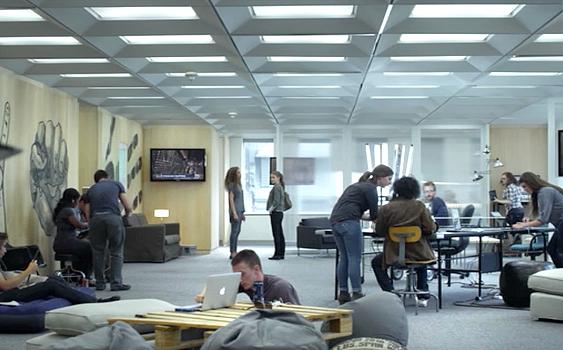
I have seen flexible workspace pop up on the tv a couple of times this year. I saw this in House of Cards.
The contrast in work ethic within each company shown was enhanced by the space. The traditional office came across as stale, whereas the second was young and inspirational. As the viewer, I was totally on board with the exciting new prospect of flexible work space and the freedom that comes with it.
What are the real benefits of co-working?
Worker output
In 1985, approximately 30% of a worker’s output depended on working with others. By 2010, this figure had risen to a phenomenal 80%, recent research testifies. It is widely acknowledged that good teamwork produces productive ideas.
Increased self-confidence
Being surrounded by a supportive community, with whom, unlike colleagues, workers voluntarily form a relationship, a large segment of workers working in the community report an increase in self-confidence. This ‘healthy’ working environment is a long way from the bullying and intense office politics that often go on in traditional places of work.
A self-directed way of working
Deskmag carried out a survey and found that 70% said they feel ‘healthier’ than working in a traditional office. A more self-directed and self-managed way of work, including choosing your own hours and people you collaborate with, has been cited as being responsible for such improvements.
And then there’s the commute
Common sense prevails that if you are driving for a significant amount of time each day, you are not optimising the productivity of your working day. Not only is spending time travelling to work essentially ‘dead time’, but it can also cause stress, particularly in rush hour traffic. The Deskmag survey found that co-workers deliberately choose working centres located not too far from home. With an average commute of about 20 minutes, precious time is not lost through hefty commutes, stress levels are reduced and again, working morale and self-confidence improve.
Case study: Google unleashes creativity with flexible working patterns
Far from being a trend of freelancers, work-from-home mums and SMEs, many large multinational corporations are executing more flexible working practices. When it comes to multinational corporations, they don’t come much larger than Google. The American corporation recently set up a 20 percent program in which Google developers get to spend 20 percent of their working day on ‘side projects’. These side projects don’t even have to be productive, and can include playing pool, jogging, etc.. Ironically, Google’s ’20 percent time’ has proved, according to ABC News, to be some of the most productive time spent at the company.
“Just about all the good ideas here at Google have bubbled up from 20 percent time, or something like 20 percent time, where people have their own idea and run with it,” Alec Proudfoot, an engineer at Google who founded the 20 percent time concept, told ABC News.
The success of the Google 20 percent factor is evidence of how rethinking company time and giving workers greater freedom and flexibility pays off.
Motivation through rewards
What motivates productivity? In the golden age of digital technology we are now firmly entrenched in, fostering creativity and encouraging employees to ‘think outside the box’ is essential to a company’s success. Workers need to be motivated through rewards. Being given the freedom, power and ‘trust’ to work flexibly, in their preferred chosen setting and to their own time-scales, is likely to see employees more willing to give something back in return – namely working more productively, creatively and harder. Such is the power of flexible working patterns.
Conclusion
There are more and more studies into the benefits of flexible space, which is primarily rooted in the attitude of employers. Showing more often that ownership is a bigger motivator than money can obviously be translated into any work environment. It is the attitude of the company. An employee deciding the way they use their time is a completely logical way to work (if you have the right staff). If I need a sofa to read for a day, it might be more productive for me than trying to force out some work that would come naturally after some inspiration.
It would be impractical for a lot of companies now to switch fully, but it is a great option for a lot of businesses. The relationship between employees and employers, and the way we work, will have to change. You may come into a flexible working environment and continue the 9-5 at a desk, that is the beauty of a flexible space, however, you may not. I am excited about the development of work culture, where productivity or creativity may be the new currency instead of time spent in the office. Workspaces should be platforms built to enhance productivity, to give empowerment to employees and to give the practicality and support of a community.
If you want to know more about co-working in Leeds or Harrogate, give us a call on 0113 385 4755
In the meantime, what are your thoughts on flexibility and productivity? Do you have any positive/negative experiences? We’d love to know your thoughts.
Manage Consent
To provide the best experiences, we use technologies like cookies to store and/or access device information. Consenting to these technologies will allow us to process data such as browsing behavior or unique IDs on this site. Not consenting or withdrawing consent, may adversely affect certain features and functions.
Functional
Always active
The technical storage or access is strictly necessary for the legitimate purpose of enabling the use of a specific service explicitly requested by the subscriber or user, or for the sole purpose of carrying out the transmission of a communication over an electronic communications network.
Preferences
The technical storage or access is necessary for the legitimate purpose of storing preferences that are not requested by the subscriber or user.
Statistics
The technical storage or access that is used exclusively for statistical purposes.The technical storage or access that is used exclusively for anonymous statistical purposes. Without a subpoena, voluntary compliance on the part of your Internet Service Provider, or additional records from a third party, information stored or retrieved for this purpose alone cannot usually be used to identify you.
Marketing
The technical storage or access is required to create user profiles to send advertising, or to track the user on a website or across several websites for similar marketing purposes.