How a Serviced Office can benefit culture in a SMB

For a start up company, creating an attractive culture within the company is important for both attracting talent to work there, and then subsequently keeping that talent with you to help develop the business. And if you’re running a start up, it’s likely you’ll attract that talent by checking the boxes on a checklist offering freedom, flexibility and perks to all the members of your team. But what if the office space you have chosen to work in doesn’t give you the freedom to provide these things? If you’re lumbered with a large office space you’ve bought or rented, then you’re not going to have enough flexibility to create the right kind of start up culture you need to foster a winning team. Serviced offices offer the best solution, as they go hand in hand with a start up business, only growing as and when the company does.

So what’s on this “checklist” of start up culture? And how can serviced offices help you check the box for each element?

1) Getting the right people for the job – it’s absolutely essential you attract the most talented people for the job, and that you keep them. Serviced offices will mean that you can literally focus 100% on choosing the right business team you need. All maintenance, reception, security and other considerations are taken care of by the serviced office provider!

2) Creating a good connection between team members – organising group activities, days out and team-building exercises is made all the easier when you don’t have to worry about the day-to-day running of the office. With all the bases covered at all times, you’re free to foster a really cordial relationship between each member of your team.

3) Giving employees the opportunity to develop – with the myriad of options available in serviced offices, you needn’t have your employees there all day every day chained to their workstations. Thanks to hot desks, virtual office services and flexible meeting rooms, employees can have the freedom they so desire to get their work done.

4) Create an enjoyable and affable atmosphere in which to work – serviced offices like those at Carrwood Park and Brookfield Court provide a light, spacious, free and open space in which to work, all surrounded by stunning grounds and gardens. They are the kind of places people look forward to going to work at.

5) Attractive perks – comfy workspace, flexible times and holidays, free snacks/meals, subsidized gym membership; just some of the perks you could offer which are made easier by the huge range of amenities available in and around serviced office parks.

So whichever way you look at it, it makes sense to choose serviced offices when running a start up company. The road to success for a start up is fret with risk and difficulties, and it’s a well-known fact that only flexibility and adaptability can shepherd the company out of the darkness and into the light! Serviced offices have these qualities in spades – take the space you need for now, and expand your usage as you grow. You can’t ask for a better deal.

Are you running a start up in Carrwood Park? Leave your comments and tell us how serviced offices are helping you to build your own ideal start up culture within your company.


6 Benefits of Choosing Serviced Office Space

For SMEs, the costs associated with leasing and refurbishing their own offices are often prohibitive. Serviced offices, where businesses have an executive suite within a large business unit, give business owners all the benefits of a modern and clean office environment, without all the management costs or initial outlay in furniture and fittings.

Offices that create an outstanding environment should cater to your specific needs whilst offering flexibility and operational support. This can allow you time and space to focus on running and developing your business more effectively and is highly beneficial to your business culture and team productivity.

Here are five business benefits of a serviced office that you might not have considered:

1. A carefully curated workspace – and its facilities

Your team requires more than a room, it needs an effective working environment – the benefits of a workspace specifically designed to inspire and support your team is essential for reaching your business goals and potential.

The WorkWell approach focuses on creating such an environment, providing highly productive workspaces that are deliberately designed around excelling best practices and workplace strategies. The services provided, from bookable meeting rooms to open-plan break-out spaces and a professionally manned reception desk, are intentionally created to enhance creativity, collaboration, and output.

This, combined with the convenient out-of-town location, ample accessible parking, and rural outside space, means WorkWell offices are ideally placed to offer all the advantages of a carefully curated workspace and the delivery of an exceptional level of service.

 2. Flexibility

Serviced offices offer unparalleled flexibility both in terms of the amount of space you require, the length of time you wish to stay, and overall agreement.

Customer centricity is the key driver for serviced offices, meaning your space can be flexed based on your business needs, including being expanded or reduced in size based on accessibility and the number of staff.

At WorkWell, we offer full consultancy, tailor-made workspace solutions to accommodate your evolving business, and with flexible lease periods, you can choose to adapt as and when your business needs dictate, without being restricted by lengthy contracts or square footage.

3. One all-inclusive fee

With a simple pricing structure for rental fees and with utilities included, serviced offices are incredibly cost-effective. As a business, you will only have one monthly fee, so you can continue to work in confidence without the surprise of unexpected costs:

The overall fee will usually depend on:

  • The size and quality of the space
  • The services and facilities on offer to your business
  • The city or town in which the building is located
  • If the space is in a desirable part of town (near transport centres or cultural hubs for example)

 4. Enhanced professional images

Your company’s image is hugely important. Your office branding, address, the standard of meeting rooms, and the availability of areas in which to welcome clients, all convey a professional image and help form a good overall perception of your business.

A professional workspace can help build trust and creditability and can lead to important long-term business relationships, as well as attracting talent to your company. This is proven by the success of the longstanding members who have continued to choose WorkWell Offices as their business base.

5. Community and networking

Serviced offices provide a valuable opportunity to network and work in a community of like-minded individuals. Areas, such as communal outdoor and open-plan spaces enable members from different businesses and industries to network, opening the possibility of finding shared business interests, opportunities, and collaboration.

At WorkWell, members have access to collective areas and communal spaces, as well as an active calendar of free social events organised by WorkWell and hosted within the landscaped grounds and workspace environment.

6. Move in and Start Working

Serviced offices allow businesses to simply move in and start work straight away. In contrast, setting up a new office, can be a lengthy process. From finding the right location to agreeing on the lease, through to decorating and furnishing, which all takes time. We cut all of that out, and provide a turnkey solution.

To access more information, or if you wish to discuss your workspace requirements, contact sales@workwelloffices.com

Networking in Leeds? A guide on how to run the perfect event

Running a great Networking Event can be a struggle for even the most seasoned organiser. We host and see a large number of networking events at Carrwood Park Business Centre in our Leeds meeting rooms, so we have the opportunity to see what works and what doesn’t. Here we will try to educate you by referring to what we have seen in our centres.

The BNI Model

BNI is one of the world’s largest networking and referral organisations. It is based upon the idea of “what goes around, comes around,” i.e. that by giving business to others, you will get business in return. All members carry several copies of your business card with them and act as additional salespeople to help members, “increase their business through a structured, positive, and professional “word-of-mouth” program that enables them to develop long-term, meaningful relationships with quality business professionals.” [BNI website]

If you are organising a one-off event, the BNI model does not work. This is because this model relies on the development of trust over time, so regular, structured events are required for this model to work. For one-off networking events, it is best to keep things simple (see advice below). Read a negative and a positive review of the BNI model on The Marketing Spot.

The Best Times for Networking Meetings. For thebest response, I always like to see a shorter evening meeting later in the day. This ensures the networking meeting doesn’t affect working hours too much, or eat into people’s evenings either. I would recommend either 4.30 pm till 7 pm on a Thursday, or a Wednesday breakfast meeting (for a young crowd, evening meetings are best).

I think a simple format works best. Begin with 45 minutes of open networking, followed by a brief 20-minute topical talk, then close with more networking. Give people what they are there for!

Opening Networking Meetings and Making Connections

For good networking, you need a good team right from the start. Please don’t force everyone to hold their hands up or ask the audience who they know – to me, this seems insincere and very impersonal. It only gives people information they can find in the yellow pages.

It is much better for your team to take time to speak to your guests when they first arrive and say, “I know someone who would be great for you to meet”. You’ve then built the relationship with them and can help them with their contacts. Really, do your homework first to make sure the introductions are relevant. Then what’s not to love about your company, if you’re doing all that for free!

Ratio of Guests Per Team Members for Networking Events

Some of the best networking companies recommend seven guests per one of your team members. This is so you have time to build up a relationship with your guests at the event. It also gives each team member a manageable number of people to find out about before the event, to make your introductions relevant. The more introductions you can think of, the better, so you can keep conversation flowing and keep breaking the groups up if you see conversation going stale.

What people want is an environment where they will meet 2,3,4, or 5 relevant people, in a relaxed atmosphere where they don’t feel too awkward to introduce themselves.  If you give them this, they will leave with a positive impression of the meeting and are more likely to recommend your company to others. Additionally, they will come back for your next event.

How Many Guests to Invite to a Networking Event?

If it is your first networking event, don’t go for 200 people, as it just won’t work. Aim to place up to 40 select people in a room with 6 or 7 of your own team. This will be enough and will be hard work to get. Remember the 50 – 50 – 50 rule: In order to get 40 people to attend, you would have to invite around 160.

Talk Topics for Networking Events

Choosing a talk topic for a networking event is very important. The more relevant the topic, the more people will be interested in attending. Take care to choose a topic that will appeal to your target market. Asking for suggestions from regular group members is an easy way to find out what people are looking for.

Positioning your business in line with the chosen speaker is an excellent marketing opportunity. For example, I could ask Savills to talk about the start-up office space market, because they are one of the largest office space agents. Hosting an event with them, therefore, aligns Carrwood Park with their business and positions us alongside them for credibility in that area.

Absolutely DO NOT try to sell to people in the topical talk. They already know who you are and what you do. You should be offering them free advice and not a sales pitch. If you must sell to them, this can be done via a phone call the next day or in a follow-up e-mail.

Concluding and Following up on a Networking Meeting

If you have done a good job of setting the networking meeting up, choosing a relevant topic and making introductions, the second part of the networking section should happen quite naturally. If your guests drift away, then you didn’t do a good job of the introductions during the first half of the event. If this happens, try to catch people as they look to leave and ask if they met x, y or z (or if there was anyone they would like to meet and didn’t), then do an introduction or email an introduction the next day.

Placing a feedback form on each of the seats will give you good feedback. Carefully crafted questions for lead nurturing will allow you to be more effective with your follow-ups the next day.

And finally, do ensure you send follow-up emails the very next day.

I hope this has given you a brief overview and some useful tips for organising networking meetings.

If you are looking for meeting rooms in Leeds or Harrogate, or would like to discuss any of these points in more detail, please do give me a call on 0113 385 4755

Personal Service From the Smaller Team

As our business has grown over the last few years, I have always regarded larger competitors in the market with a certain amount of envy, because they have greater resources to exploit the opportunities before them. Right now, even with four serviced office centres running and an additional 150,000 square feet leased, we remain far behind those big industry players. But then, just the other day, something happened at one of our business centres that made me realise that rather than competing with the huge teams and grand scale of the competition, we should be happy with doing what we do, not only well (as we do), but also on a personal level.

Recently, a centre manager at Carrwood Park received an unknown parcel destined for one of our brave servicemen in Afghanistan, but it had been returned to us. With no obvious markings on the package for a return to sender, we opened the package and discovered it contained certain items prohibited from being posted by the army. It had only reached Carrwood as it had been repackaged in a box with our address on it and had nothing to do with us.

Without a second thought, we decided it best to remove these items and get the parcel back on the road (paying the fees) with an explanatory note to the soldier who was no doubt eager to receive it. The removed items were then returned to the sender once we established who they were. A situation was encountered, and it was swiftly dealt with by the team in a professional manner that I hope helped the soldier in whatever little way we could. It was an obvious answer that I hope any individual with autonomy would have done to represent their company sensibly and help our troops.

Now let’s picture the same scenario but in a much larger organisation. You’d think that the people, power and resources of a huge company would make the process even more efficient, right? Wrong! It’s hard to even ascertain from larger companies how far up the chain something has to go before a final decision can be made. Needless to say, it would have sat in the corner of a store room or done its rounds in the postal service before being put in a lost post container.

The Advantages of a Small Team

In his article “The Smaller the Better”, Jeffrey Phillips outlines the advantages of having a smaller team working in a department or on a project:

1) Focus and clarity – each member is aware of what they have to do and what everyone else is doing

2) Better chance of good cohesion between team members

3) Less time required for training and administration of each employee, thanks to fewer people being on the learning curve

4) Easier interaction and communication between all team members

5) No single team member can hide or take a back seat from their assigned duties, so common sense has to be used.

At WorkWell, the smaller team is empowered with the right to use their own judgment to get a task done when it needs to be done, not when someone upstairs says it can be done. Such an operation brings enormous benefits to everyone:

  • A staff with whom you can become familiar with their abilities, working style, strengths and weaknesses
  • Every member of staff has a name, a face, a number, and an e-mail – it’s a true personal service
  • No waiting around – the job gets done because the team is empowered to make the right decision when they see it

So when looking at your competition with envy or their size and resource, spend a second to think what disadvantages this brings with it and often it is in a place you can exploit and excel as a small personal business.

So on a final note which of the above scenarios do you think best represents the image you want your business to portray? If you are a small dynamic business or division put your trust in a team that has been trained and trusted to do the job right. Visit  WorkWell and witness what good it can do for you and your business.

Virtual Phone Numbers: Should I get one?

When you’re starting a new business alone, keeping a constant eye on your business phone line can be very difficult. Similarly, when your business takes off but staff numbers are limited, busy times of day can mean calls are missed, and with them, new business opportunities. In these situations, having a virtual office set up with a virtual phone number is really a good choice for your business.

 A virtual phone number gives you a constant connection with both your existing customers and potential new ones. It’s also incredibly handy if you’re wanting to expand your business to a local area but don’t want to physically move there. A local number in the area gives you a presence there without going through the expense and difficulty of actually being there. You can set up a phone line in any city you need, while being headquartered in another.

While sounding incredibly high-tech and potentially complex, setting up a virtual office with a business phone line is actually quite simple. Once you’ve found a dedicated provider of such services, you can gain peace of mind that every important call will be answered with total professionalism, and you’ll never miss out on key business opportunities again.

There are numerous other good reasons to think about a virtual phone number for your business:

1) Answering machines and voicemail are convenient, but not 100% reliable. A power cut could erase all records of messages received.

2) Many people find them impersonal and would always prefer to talk to someone real, even if it’s not the person they wanted originally.

3) A virtual office receptionist gives you the professional image you need without the overheads of maintaining and running a reception yourself.

If the option is open for you to tailor your new virtual telephone number, then you should take that chance and put some thought into the number itself. It’s an optional extra, but you might find that putting that professional touch at the end of your business card is worth the extra cost.

Virtual Office Service: The natural choice for many

Virtual office services are not just for small startups and one-man-band businesses. Well-established companies can also benefit from simply always knowing that any and all phone calls will be answered with professionalism and efficiency. If you want to know more about virtual telephone numbers and other virtual office services, visit our website at https://www.workwelloffices.com/

Keeping Cool in the Summer

Summer is just around the corner, and that means it’s time to flip that switch and set your air conditioning to cool. If you’re already lucky enough to work in serviced offices with top-of-the-range air conditioning systems like those at WorkWell, then stick to these guidelines to keep your working environment cool in those sweltering summer months.

Keep the temperature set to 19°C

If, in your overheated stupor, you set the temperature to the lowest setting possible, your office space will eventually get too cold. Inevitably, this will lead to people turning it up again, making it too warm. Prevent these time- and energy-wasting air conditioning wars by keeping the temperature nice and constant — 19℃

Set it to “cool” and not left on “automatic”

Check the function setting on your system and ensure that it’s kept on the “cool” function. This is usually denoted by a snowflake.

Keep it running all night

Stopping the system overnight means you start from square one the next day. Keeping it running through the night will leave your workspace with a lasting pleasant temperature throughout.

Keep windows and doors closed

The classic answer to being too hot — opening windows and doors — this may have worked in the dark ages before air conditioning was even conceived, but in modern office spaces this is wasteful and counterproductive. Keep all windows and doors shut to ensure maximum efficiency in your a/c system.

Turn off all unnecessary electronics

Many electronic devices generate heat themselves and so will counteract the effects of your air conditioning. Make a new summer motto for those surplus devices — If it’s bringing heat in, take its plug out! Hopefully, this guide will keep your office cool and comfortable, and in turn keep your employees happy and productive. But if a/c is a long-standing issue in your current office space, take a look at the fantastic (and well air-conditioned) office spaces, meeting rooms and more at WorkWell and get your summer business schedule underway

Five furnishing trends that will enhance productivity in the workplace

Now that we’re in 2025, we can see that the business world has gone truly global, and with that comes stiff competition. It’s now more imperative than ever to keep employees as productive as possible, to give companies a fighting chance to survive in the new global market.

Company management will always devise new ways to boost productivity, whether it be through extra bonuses, days off, or even pizza vouchers! But there are other ways that you might not have considered — like taking a closer look at your office furnishing. Take a peek at this handy guide to furnishing trends designed to enhance productivity in your workplace.

Investing in high-quality chairs

This is a basic, but essential, first step to boosting productivity. Equipping an office with high-quality office chairs, and those with 5 points of adjustment, creates a more comfortable perch for employees to work effectively.

Providing power points to desktops

Have you seen how many gadgets the average employee has on them these days? Their whole lives are on charge! Provide access to power points at their desks, allowing them to charge their smartphones, tablets and other gadgetry. These are also useful in break areas.

Offering a “3rd Space”

Office life is no longer a case of “one has to be at one’s desk to be working”. Kit out a 3rd space where employees can get away from their desks for a time while continuing their work.

Using natural materials

Artificial materials like plastics, nylon and polyester may save you money in the short term, but the fact is they’re pesky, uncomfortable and environmentally unsound. If we all got a penny every time they gave us a static shock… Woollen fabrics are more comfortable and sustainable, and hemp gives unbeatable durability. Finally, materials with woven-in nettle fibres have a natural chemical-free fire resistance

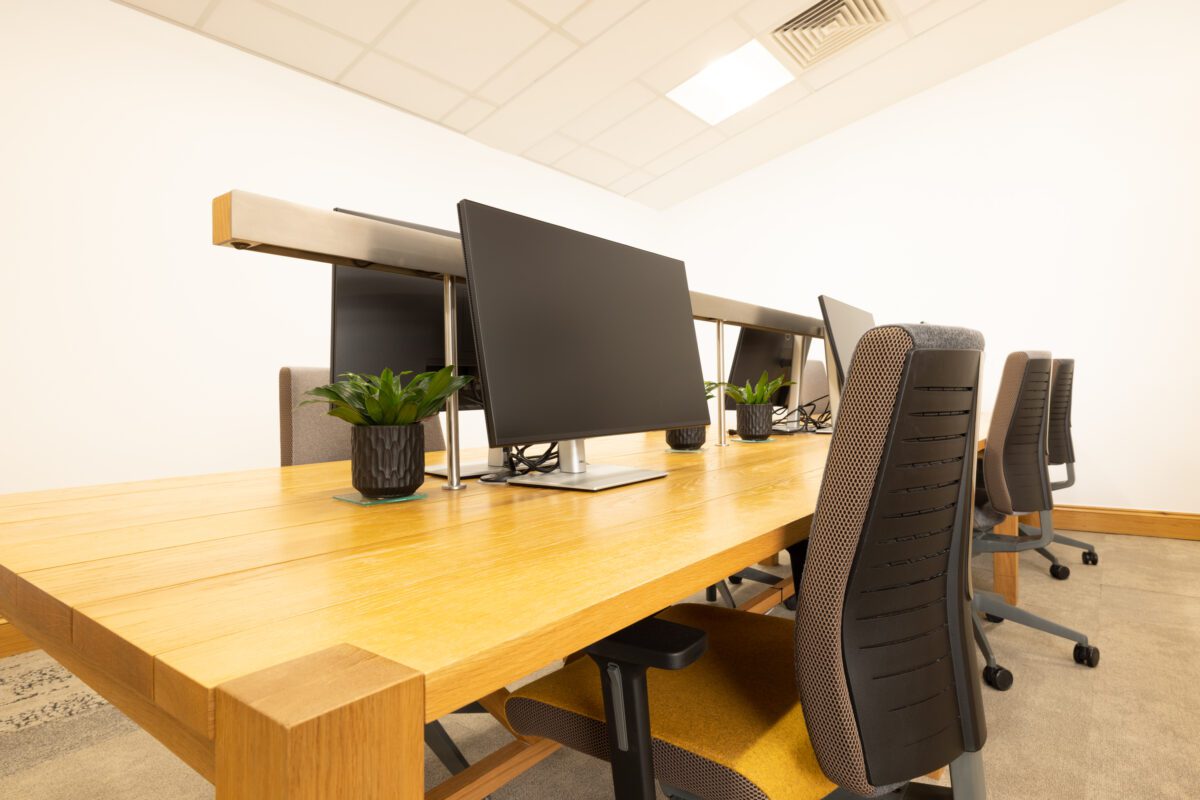
Allowing two monitors per computer

Give your employees more screen space so they can get more info up at once — they can get so much more done!

The above may as well have just been a direct description of the office spaces at WorkWell, more details of which can be found on our website. Companies coming to us enjoy furnishing to the highest possible standards, thanks to our steadfast furniture partner, Richardson’s – find out more about their innovative range at www.richardsonsoffice.co.uk

5 signs you’re ready to leave the home office

A home office — no more getting up at 6 am, no more commuting, no more traffic jams, no more office politics.

It sounds ideal to most people, but after a while, things can start to change, and one realises that perhaps their having a home office is becoming less and less a good idea. Below are several signs that it’s time to move on and change to a new office environment:

You’re afraid you’re not making a good professional impression.

No matter how much you spruce up your home office, you still may feel uneasy or unprofessional inviting clients to your home to discuss work. Having a professional business address is an important step in building the confidence and success to expand and improve one’s company image.

You’re becoming less productive

In the beginning, you were so excited about being able to work in the relaxed atmosphere of your home; working from the sofa, having the stereo on, being free to take as few or as many breaks as you want. But there comes a time when things get too relaxed and you find yourself getting less and less done each day. This is the time to move on.

You’re feeling lonely

The idea of a quiet space for yourself to get work done sounded ideal initially. But as you get into it, you discover that there was a social aspect to an office that you now miss. Choosing a co-working serviced office space is a perfect remedy for this, as it gives you the chance to work alongside like-minded small business owners. Hey it might even allow you to do some networking.

You can’t achieve a good work-life balance

One advantage of working in an office is that when you finish work, you leave the office behind and get some real downtime at home. When your home is your office, you can never get a real clean break from it, and sooner or later it will start to take over your life, and you’ll find it harder and harder to relax at home.

You’re ready to hire

Business is booming and you need to take on staff to help out. You could allow them to work from their own homes, but in fact working in an office with them allows you to train them more efficiently and build up a closer working relationship. An office space with more people in also becomes a stronger ideas zone.

Are you currently working from home? Perhaps you’re already experiencing some or all of the above. Let us know your experiences and perhaps WorkWell can offer the solution you need.

Mastering your desk set-up: The what and how

If you do even the quickest search for ideal desk set-ups on Pinterest, you will be greeted by thousands upon thousands of inspirational ‘deskscapes.’ From minimalist Mac setups to multi-screen tech-heavy setups, there is a whole chorus of arguments all claiming to have the right answer.

But one thing that we’re certain of is this: the way you set up your desk will have a huge impact on your working day. The technology you can easily access, the comfort level of your seating arrangement, and how inspired your surroundings make you feel will all feed into how productive you are.

It’s probably fair to say that there is no definitive ‘perfect’ desk set up. The ideal desk will differ from employee to employee, so it may be wise to allow each member of your team a level of freedom and personalisation when it comes to setting up their own personal workspace.

Whether you’re preparing to set up your own workspace, a selection of meeting rooms or a whole fleet of office suites, we’d advise keeping the following three considerations in mind.

Ergonomic furniture

If you want your team members to be as efficient as possible, it’s important to consider their comfort. Badly considered desks and desk chairs could lead to aches, pains and even limiting health conditions such as carpal tunnel syndrome. As many as a third of office-related injuries are believed to be caused by poor workstation set-up.

According to ergonomic principles, the ideal workstation should place the top of the monitor at eye level or just below, with the monitor about an arm’s length away from the body. The chair is arguably the most important element to the whole thing, since it is the chair that needs to support you properly throughout the vast majority of the working day. 

 It needs to be easily adjustable in case others might need it too, and it should provide support to the whole body when it is seated in a variety of postures. You know that a chair is ergonomically sound if it allows good circulation in the thighs and allows the posture to be maintained with little physical effort. But possibly the most vital consideration when choosing the chair is to ensure that, in height and overall dimensions, it is suited to the type of desk you have opted for.

Keeping the necessary tech close by

The twenty-first-century office runs on technology. Your team will constantly be using digital equipment such as a laptop, smartphone, tablet, webcam, microphone, scanner, printer and smart screen. If you want your employees to be as productive as possible, it makes sense to ensure they have vital tech equipment to hand.

Keep the computer monitor between 20 and 40 inches from your face to minimise the risk of eye strain. Also, adjust the monitor so that the centre sits nicely at eye level. Or, if you are a wearer of bifocals, set the monitor around 15 degrees below eye level so that you can see it comfortably when you tilt your head back slightly to look down at it.

Keeping the space aesthetic

We humans are generally visual creatures. Simply put: we like things to look nice! The way a workstation looks will most certainly have an impact on how productive your team members are on a day-to-day basis. And from files to bottles of water, the general clutter of an office desk can be extremely distracting. Even something as simple as having computer wires on your desk can impact productivity.

Although there’s no specific ‘perfect’ desk set up, as you can see, there are plenty of things you can do with your desk to create a more positive impact on your employees.

The serviced offices at WorkWell are fitted out with high-quality and compliant furniture meeting all the above requirements. Taking on serviced office space here removes the worry of having to meet the requirements yourself! If you’re hoping to rent an office in Leeds or Harrogate, why not find out what WorkWell can offer?

Is buying your business property the correct choice?


Companies all over the world have long held the view that a sensible use of money is to invest in a property to call their very own.

The disadvantages of buying your business property

Owning a property represents an extra expense which, on closer inspection, can come off as frivolous and unnecessary, especially when you see that renting can bring annual savings reaching millions of pounds.

When you buy property, you are also buying into a potentially disastrous lack of flexibility. The more flexible you want to be, the more property you’re going to have to buy. Renting spaces for office use, meetings, conferences, or other special projects means that you can take on more space exactly when you need it and where you need it and ensures you’re not wasting money on guessing what might be. It also brings advantages to your employees, often slashing commuting times and boosting productivity.

The advantage of renting your business property

It was thought that a private building would speak volumes about a business’s strength and stability as a company. And what’s more, it was commonly accepted that buying a building was a solid long-term investment in a solid asset that could act as a safety net if more turbulent times came along.

However, the tides of change have come, and the waters are closing over this prized maxim. A new wave of property rental has swept the world, proving its worth to companies large and small. From global megalith Walmart and its mere cluster of buildings surrounding their central warehouse, to smaller companies like Yell in the UK, who have recently given up their privately owned branch offices, companies large and small are now feeling the benefits of renting office space instead.

Unless you are a property dealer, why tie up more and more of your money in properties? If property is what you’re after, then it’s better to deal exclusively in property. Renting will allow the valuable capital in your business to work for a much more favourable return. Make a smarter move and explore the myriad of rental options available that can save you a fortune.

Renting frees up funds, reduces exposure to unforeseen maintenance and repair costs (which fall to the landlord) and provides a safer, more adaptable workspace for your team.  You aren’t locked into the location; renting makes relocation simpler. Letters aren’t locked into a sales process; you can simply exit the tenancy and move on.